
Building Codes and Regulations
The two primary organizations that establish regulations for mezzanine floors are the International Building Code (IBC) and the Occupational Safety and Health Administration (OSHA). The IBC was developed by the International Code Council (ICC), founded in 1994. It is a standardized set of building regulations to ensure the safety, health, and welfare of a building’s occupants. The IBC is widely adopted across the United States, with each state or local jurisdiction implementing amendments as needed.
OSHA, on the other hand, was established in 1971 as part of the U.S. Department of Labor to ensure safe and healthy working conditions through regulatory standards and enforcement.
Key Differences and Approaches to Mezzanine Design
While both IBC and OSHA prioritize safety, their focus areas differ. IBC governs the overall structural integrity of buildings, ensuring compliance with building codes related to load-bearing capacity, fire protection, accessibility, and general construction safety. OSHA, in contrast, is specifically concerned with workplace safety, regulating elements such as stairways, ladders, and guardrails to prevent workplace injuries and falls.
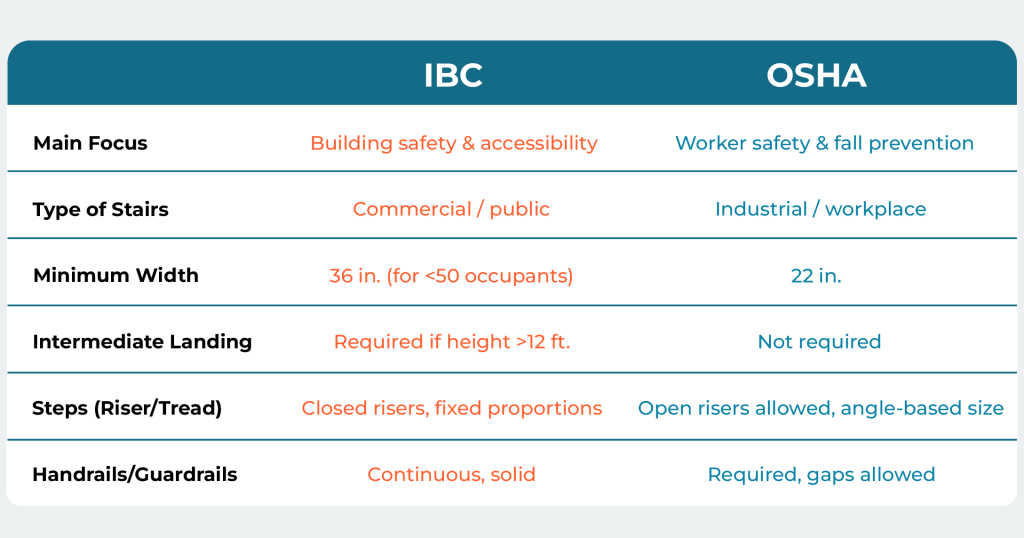
Despite their different scopes, there are areas where IBC and OSHA regulations overlap—for example, stair construction.
- IBC sets standards for commercial stairs intended for public use.
- OSHA establishes requirements for industrial stairs used in workplaces.
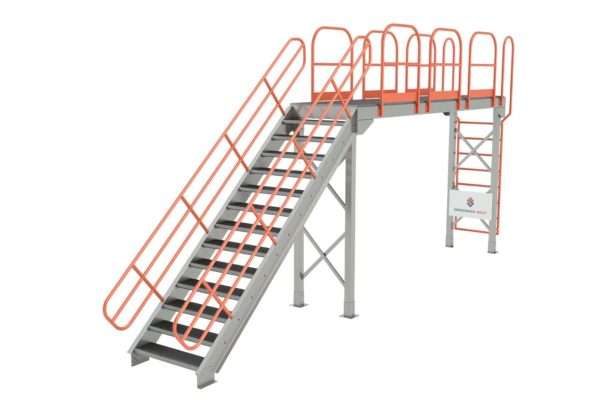
According to IBC, stairways serving an occupant load of fewer than 50 people must be at least 36 inches wide. Stairways exceeding 12 feet in height require an intermediate landing, which must be at least as wide as the stairway and extend at least three feet in length.
Similarly, OSHA specifies minimum dimensions for workplace stairs. OSHA-compliant stairways must be at least 22 inches wide, with rise and tread dimensions determined by the stairway’s angle. For example, a 45-degree stairway must have a minimum rise and tread of 8.75 inches each. Unlike IBC, OSHA allows open risers. While handrails and guardrails are required, OSHA permits gaps between rails since these stairways are not intended for use by children.
While IBC focuses on overall building safety, OSHA directly addresses worker protection, particularly the risk of falls and workplace injuries. This distinction illustrates how each organization influences mezzanine design differently, depending on whether the primary concern is structural integrity or employee safety.
Permits and Approvals
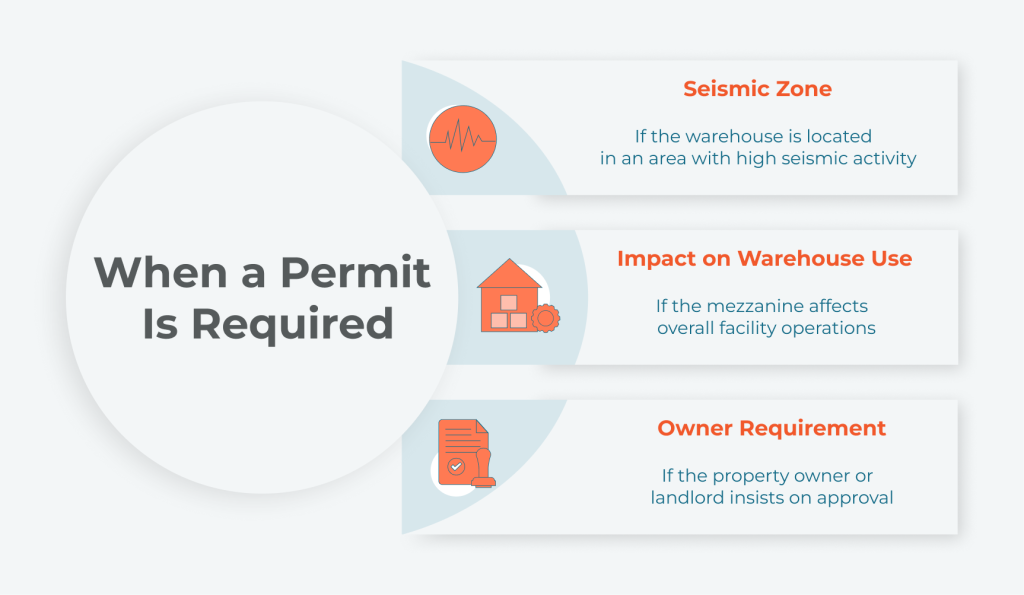
To begin with, not all municipalities require permits for warehouse mezzanines. However, if your warehouse is located in an area with high seismic activity or the mezzanine impacts overall facility usage, be ready for your municipality to require proof of approval from a licensed engineer. This provides confidence that your facility will maintain a safe environment for workers. Furthermore, some property owners may insist on permit approval, even if the local government does not.
Unfortunately, navigating the approval process can sometimes be challenging. Why is that? Recall the example of the stairways above. Officials require time to determine whether you are applying for a permit for a permanent mezzanine, which must comply with IBC standards, or if you are installing mezzanine work platforms, pallet rack mezzanines, shelf-supported mezzanines, and steel mezzanines, which fall under OSHA compliance requirements.
How does the application process look like?
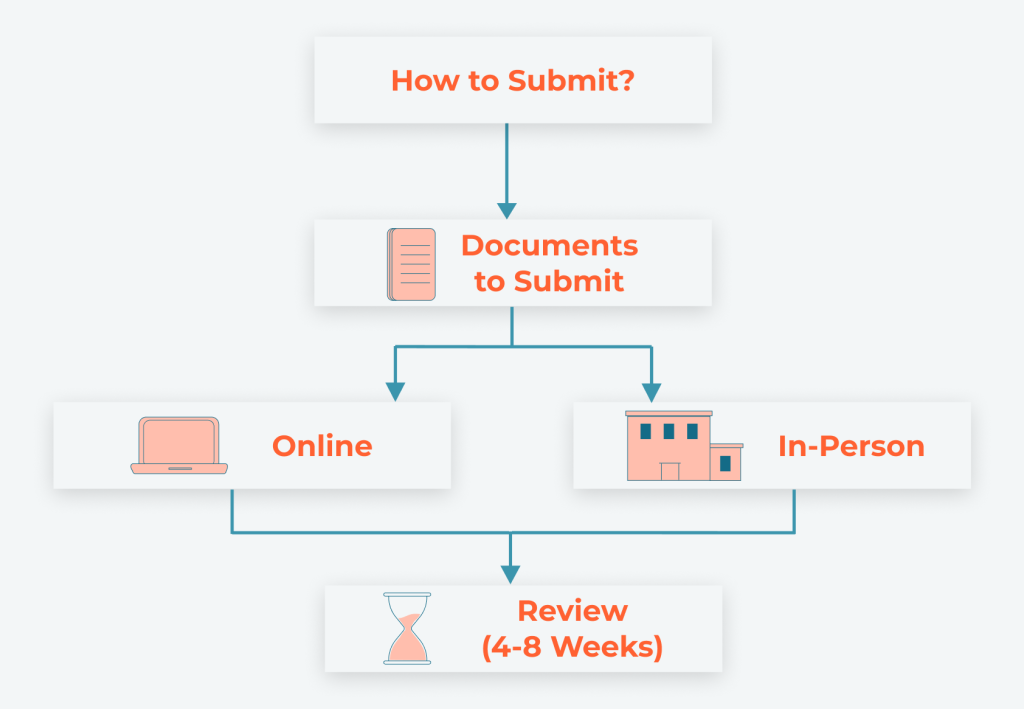
Determine if the city/county has an online permit application. Some cities require permits online, some are optional, and some require in-person.
Online. If you can submit online, (Hillsboro, Eugene, Portland) create an initial application. Once you submit the initial application, within a day or two, they will give you a permit number and allow you to start uploading the required documents.
In-person. If you must submit in person, prepare all the documents below and bring them to the permit office.
Documents to submit:
- CAD Drawings (Site Plan and Layout)
- High Pile Storage form (if over 12’ top of product)
- Seismic Calcs
- Permit application form
Don’t worry about the paperwork — we’ve got it covered.
Get a free consultation and full end-to-end support.
Once the documents are submitted, it takes the city about 4-8 weeks to review. They’ll contact you with questions, or they’ll just notify you when the permit is approved. Some cities may have a fast-track option to get the permit approval faster, but there are some stipulations. For example, Portland has their “facilities program” that allows for expedited permits, but only some buildings are in the program. You can ask our project manager for details. We may need to pick up the permit ourselves. The physical permit will need to be on site during the installation.
Safety Requirements
Ensuring mezzanine safety is a priority for protecting workers and maintaining operational efficiency. Key mezzanine safety standards include:
- Fall protection measures like guardrails, safety gates, and netting to prevent falls.
- Guardrail requirements to ensure handrails meet OSHA and IBC height regulations.
- Fire safety codes, including sprinkler systems, fire-rated materials, and proper egress routes, to comply with NFPA and IBC fire protection standards.
- Load capacity guidelines to ensure multi-level storage platforms can safely support anticipated weight loads based on engineering calculations and material specifications.
We have covered these aspects in detail in our article.
Regulatory Compliance Table:
| Section | Regulation/Standard | Reference Number |
|---|---|---|
| Floor | Load capacity guidelines | OSHA 1910.22, IBC 1607 |
| Handrails/Guardrails | Guardrail and handrail heigh | OSHA 1910.29, IBC 1011.11, IBC 1014.2, IBC 1015.3 |
| Staircases/Stairways | Stair dimensions and safety | OSHA 1910.25, IBC 1011.5.2, IBC 1011.6, IBC 1605 |
| Safety Gates | Access control and fall protection | IBC 1607.8 |
| Surface/Fall Protection System | Walking-Working Surfaces | OSHA 1910.29, OSHA 1910.22 |
| Fire Safety Systems | Fire suppression and evacuation | NFPA 13, IBC 903 |
| Emergency Exits | Egress requirements | IBC 1009, OSHA 1910.36 |
Compliance Factors
To maintain compliance, structural mezzanine components must meet specific accessibility standards. Inspections shall include checks for structural integrity, functionality of safety equipment, and load capacity compliance.
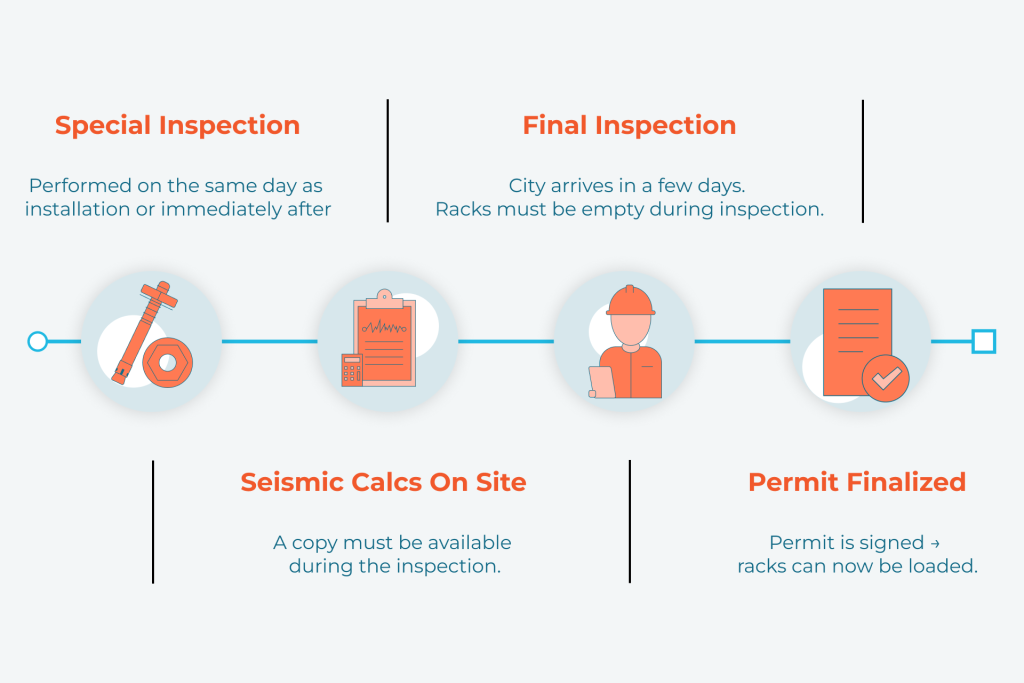
Special Inspection tests the anchors. Schedule the inspection to be done on the same day as the installation or immediately after it.
It’s usually convenient to have it done the same day as the installation (towards the tail end of the installation). If the inspectors have questions for the installers, they can ask them while they’re there. If the inspectors don’t like something, the installers can fix it. During the inspection, make sure a copy of the seismic calculations is on site.
Once you have the Special Inspection, and everything looks good, call the city to schedule the Final Inspection. Within a few days, the city will come out to do the inspection. Make sure that there are no products stored on the racking before the final inspection. As soon as the Final Inspection is complete, the inspector will sign the permit, and it is now “finalized.” The customer can begin loading the rack, and the permit process is complete!
Save your checklist to quickly check whether your warehouse is suitable for a mezzanine floor.
In the end, the big question is this….
Who Is Responsible for Ensuring Compliance With Regulations?
Responsibility for ensuring compliance with custom mezzanine designs and pallet racking mezzanine kits regulations falls on multiple parties. Building owners and facility managers must obtain the necessary permits and comply with local codes before construction begins. Structural engineers and architects play a crucial role in designing mezzanines that meet safety and building standards. Contractors and installation companies are responsible for following approved plans and using materials that meet regulatory requirements. Occupational safety officers and workplace inspectors enforce OSHA and ANSI standards through inspections and hazard identification. In the end, maintaining compliance is a collaborative effort among all stakeholders involved in mezzanine planning, installation, and ongoing operation—but ultimately, the responsibility falls primarily on you. To ease this burden, seek professional assistance.
From permits to final inspection—we’ve got you covered.
Let us walk you through every step of your mezzanine approval process.
Products, discussed in the article


Was this helpful?